01 / THE PLACE
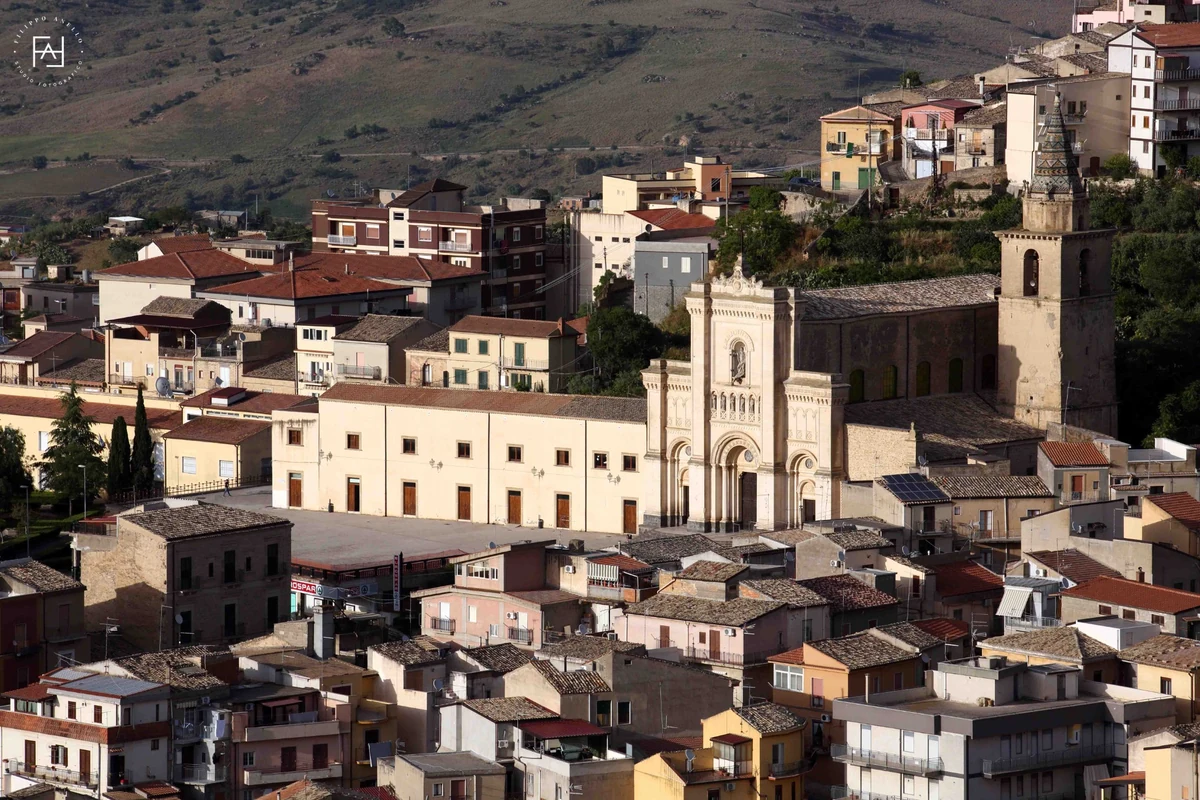
A flight of steps, a façade, a place connected to Agira’s religious heritage. Stop at San Filippo Abbey and let the story guide your gaze.
LISTEN TO THIS PLACE
The abbey, narrated.
An introduction and seven chapters: listen in sequence or choose one at a time. This audio guide is in English.
Audio in English · 8 chaptersIntroduction
- Listen 0:30
Introduction
Read the transcript
Welcome to the Abbey of Saint Philip, one of the most important religious monuments of Agira.
Its history is deeply connected with Saint Philip, a Basilian monk of Syrian origin who, according to tradition, founded a monastery here between the seventh and eighth centuries.
For centuries, this place was an important centre of monastic life, spirituality, art, and culture in Sicily and southern Italy.
Let us begin our journey through its fascinating history.
- Listen 1:01
The Origins of the Abbey
Read the transcript
The Abbey of Saint Philip was originally part of an ancient monastery founded by Saint Philip himself.
The monastery became one of the most important centres of Basilian monasticism in Sicily. Until around the tenth century, many important monks and saints from Sicily and southern Italy are believed to have studied and trained here.
In 1126, the monastery was united with the Abbey of Santa Maria Latina in Jerusalem.
A few decades later, during the Third Crusade, the political situation in the Holy Land changed dramatically. Between 1187 and 1192, after the conquest of Jerusalem by Saladin, many monks were forced to leave the city.
A large number of them found refuge here in Agira, and the monastery became the new seat of the abbot.
It was probably from this period that the abbey also became known as Santa Maria Latina.
- Listen 0:59
Decline and Transformation
Read the transcript
For several centuries, the abbey remained an important religious institution, but its decline began in 1474.
From that time, its administration was entrusted to so-called commendatory abbots. These abbots often lived far away and were more interested in the revenues connected with the title than in the daily life of the monastery.
As a result, the religious community gradually weakened.
In 1635, the last monks finally left the abbey and moved to the monastery of San Nicolò in Catania.
The church, however, continued to survive and was later transformed.
Much of the interior that you see today is the result of the work promoted by Abbot Giuseppe Maria Gravina, who lived between 1736 and 1812.
His interventions gave the church much of its present appearance.
- Listen 0:59
The Façade
Read the transcript
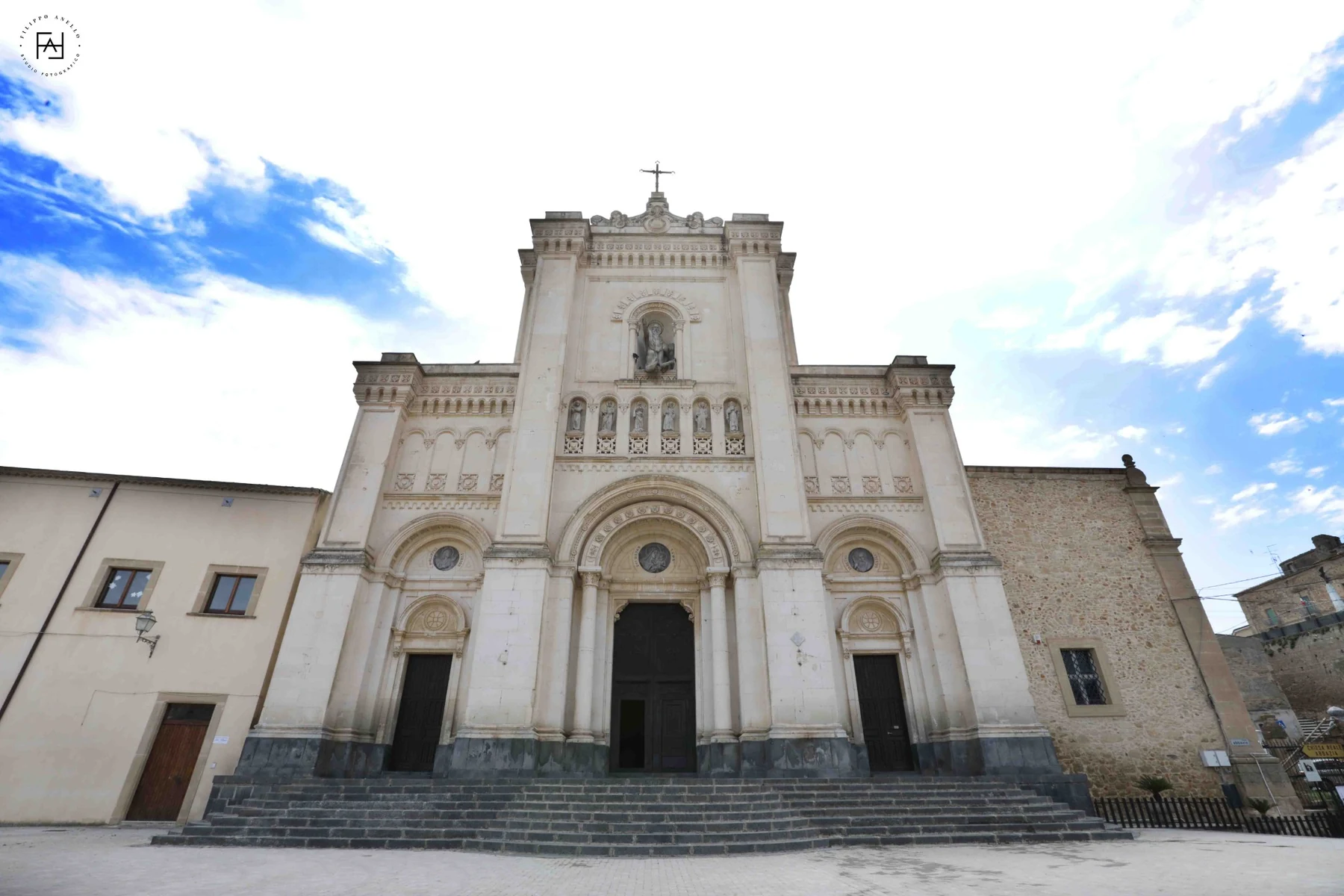
The present façade is relatively recent compared with the long history of the abbey.
The eighteenth-century façade collapsed in 1911 and was later replaced by the one you see today, built between 1916 and 1928 according to a design by engineer Giuseppe Greco.
Its composition is simple and balanced, but rich in symbolic details.
At the centre, a large niche contains a sculpture of Saint Philip defeating the devil.
Below and around it are six smaller niches containing statues of the patron saints of the other historic parishes of Agira.
The sculptures were created by Antonino Morina.
Above the main entrance, a medallion represents Santa Maria Latina, while above the two side doors you can see Saint Philip the Deacon and Saint Eusebius.
- Listen 1:06
The Interior and the Choir
Read the transcript
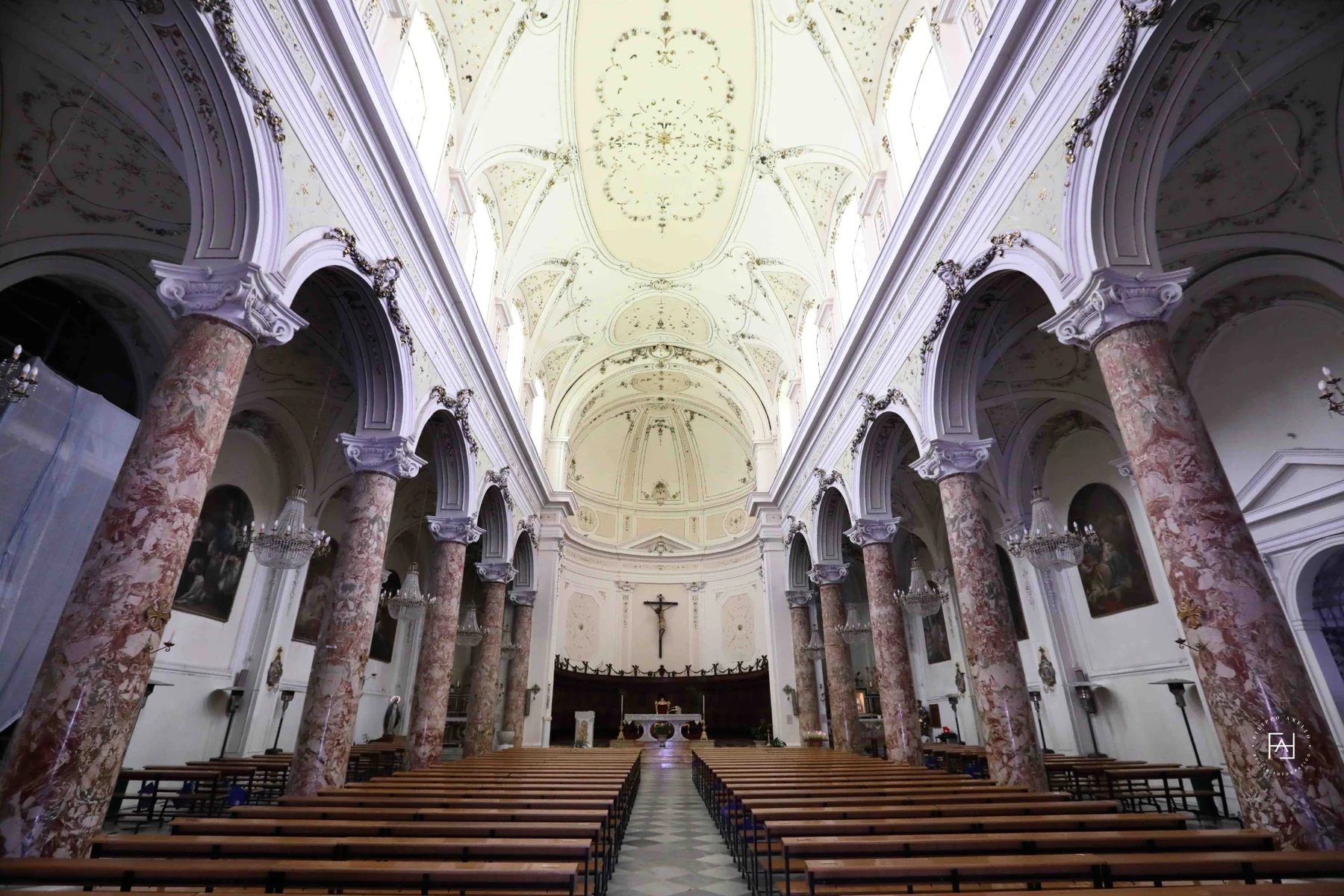
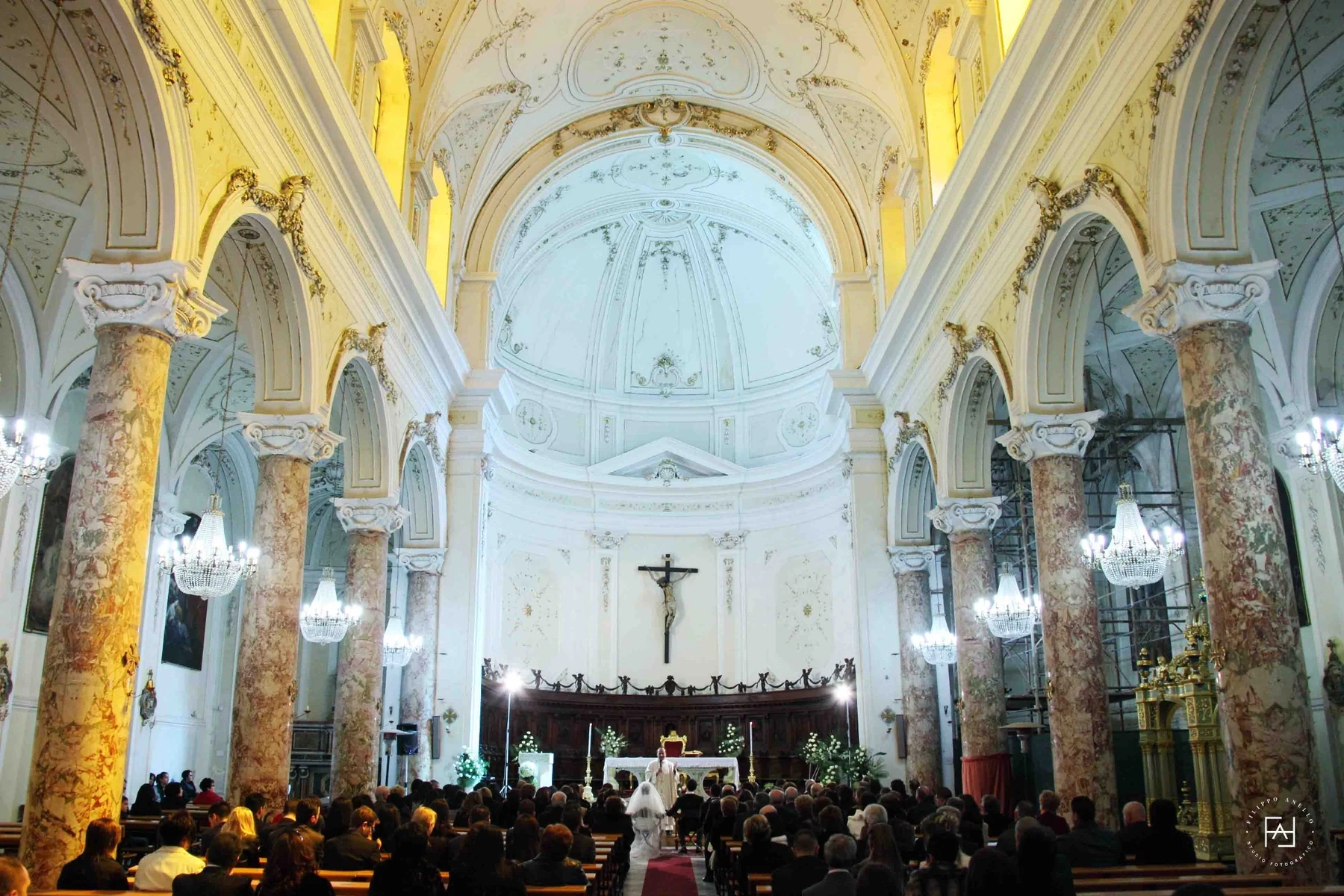
As you enter the church, one of the first things you may notice is the elegant division into three naves.
The columns are covered with red marble, creating a strong visual contrast with the lighter decoration above.
The vault is enriched by refined Rococo decoration, created in 1783 by the brothers Pietro and Paolo D’Urso from Leonforte.
In the presbytery, one of the most remarkable works is the large walnut choir, created between 1818 and 1822 by Nicola Bagnasco.
Its carved panels are not simply decorative.
Twenty-five separate scenes tell episodes from the life of Saint Philip, transforming the choir into a kind of visual biography carved in wood.
Above the altar, you can also admire a dramatic seventeenth-century wooden crucifix by Fra Umile Pintorno of Petralia.
The crucifix originally came from the former church of Santa Maria di Gesù.
- Listen 1:08
Paintings and Artistic Treasures
Read the transcript
The walls of the church preserve an important collection of paintings produced between the fifteenth and nineteenth centuries.
Among them is a work by Matteo Desiderato showing Saint Philip giving the Gospel to Saint Philip the Deacon, painted in 1806.
You can also admire works by the Sicilian painter Olivio Sozzi, including a Holy Family and a Pietà.
Giuseppe Velasquez is represented by paintings of the Madonna enthroned with Saints Basil and Benedict, and the Madonna of Montserrat.
Other important works include The Dying Saint Agatha by Matteo Riccio, dated 1670, and a Madonna of the Rosary by Filippo Randazzo.
Particularly ancient are three fifteenth-century panels by Giovanni di Pietro, probably surviving elements of a larger polyptych.
They depict the Madonna in Majesty, Saint Benedict, and Saint Calogero.
At the feet of the Virgin appears Abbot Jacopo Paternò, who commissioned the work.
- Listen 1:04
The Relics of Saint Philip
Read the transcript
One of the most important sacred treasures of the abbey is a finely crafted silver reliquary dating from the early seventeenth century.
Inside are preserved relics traditionally associated with Saint Philip.
From the left nave, a staircase leads down to a lower chamber known locally as the Cateva.
According to popular tradition, this is the burial place of Saint Philip.
Inside, you can see a beautiful sixteenth-century marble sculpture representing the saint lying in death, attributed to Francesco Méndola.
Above it is a funerary niche decorated with a relief traditionally linked to the workshop of the Gagini family.
In 1599, remains attributed to Saint Philip, Saint Philip the Deacon, Saint Eusebius, and Saint Luke Casali were discovered in this area.
For many visitors, this is one of the most spiritually significant parts of the entire complex.
- Listen 0:57
The Sacristy and the Archive
Read the transcript
The abbey also preserves important historical treasures beyond the main church.
In the sacristy, you can admire a large walnut cabinet made in 1735 by local craftsmen.
Its fine carving is another example of the high level of craftsmanship that developed around the abbey.
Even more remarkable is the historical archive.
It contains four hundred and twenty-nine parchments forming the collection known as the Tabulario of Santa Maria Latina of Jerusalem in Agira.
These documents are of great historical importance because they preserve evidence of centuries of religious, economic, and social life connected with the abbey.
Many of them remain largely unpublished, meaning that this extraordinary archive may still contain stories waiting to be rediscovered.
Thank you for joining us on this tour of the Abbey of Saint Philip. We hope you enjoyed discovering its ancient monastic history, sacred relics, architecture, and artistic treasures.
Don’t stop here—Agira is full of fascinating churches, monuments, and stories waiting to be explored. Be sure to listen to our other audioguides and continue your journey through this beautiful town.
HISTORY AND LANDSCAPE
A story to listen to.
The abbey is one of the places connected to Saint Philip and the town’s religious heritage. Begin outside with the façade and steps, then continue inside when the church is open.
The audio guide explores the origins of the abbey, its transformations, the façade, the interior and the choir. Later chapters focus on paintings, the relics of Saint Philip, the sacristy and the archive.
Explore at your own pace.
Listen from the beginning or choose an individual chapter. Use headphones and respect quiet moments and services: listening does not require access to every space mentioned.
The abbey and the patron saint’s festivals.
Devotion is renewed through the Spring Festival on 12 May and the Summer Festival, A festa ranni, held on 12 August in recent years. Discover the traditions and the connection with Żebbuġ, Malta.
Discover Saint Philip’s festivalsTAKE A CLOSER LOOK
Details make the place.
The façade and steps
Begin outside: take in the whole building, then look at its details while listening to the chapter on the façade.
The interior and choir
If the interior is open, continue with the relevant chapter. Follow the guidance displayed in the sanctuary.
Art and devotion
Paintings and relics are two themes in the audio guide. Choose the chapter that interests you and take time to listen.
THE PLACE, IN PICTURES
Change your perspective.
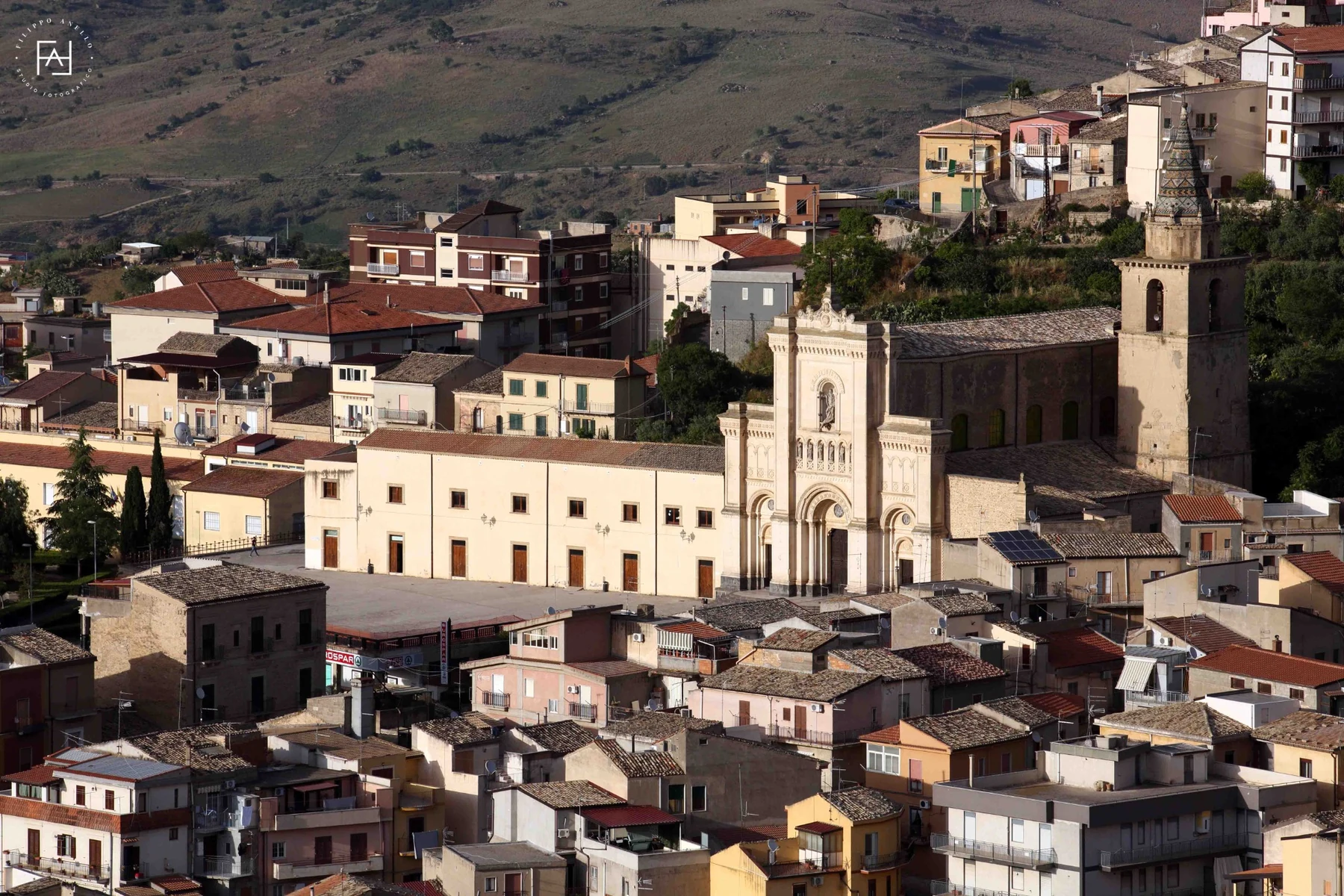
A closer look at the details and the surrounding landscape.
KEEP EXPLORING
One stop. Many directions.
Keep exploring Agira, with time for breaks.