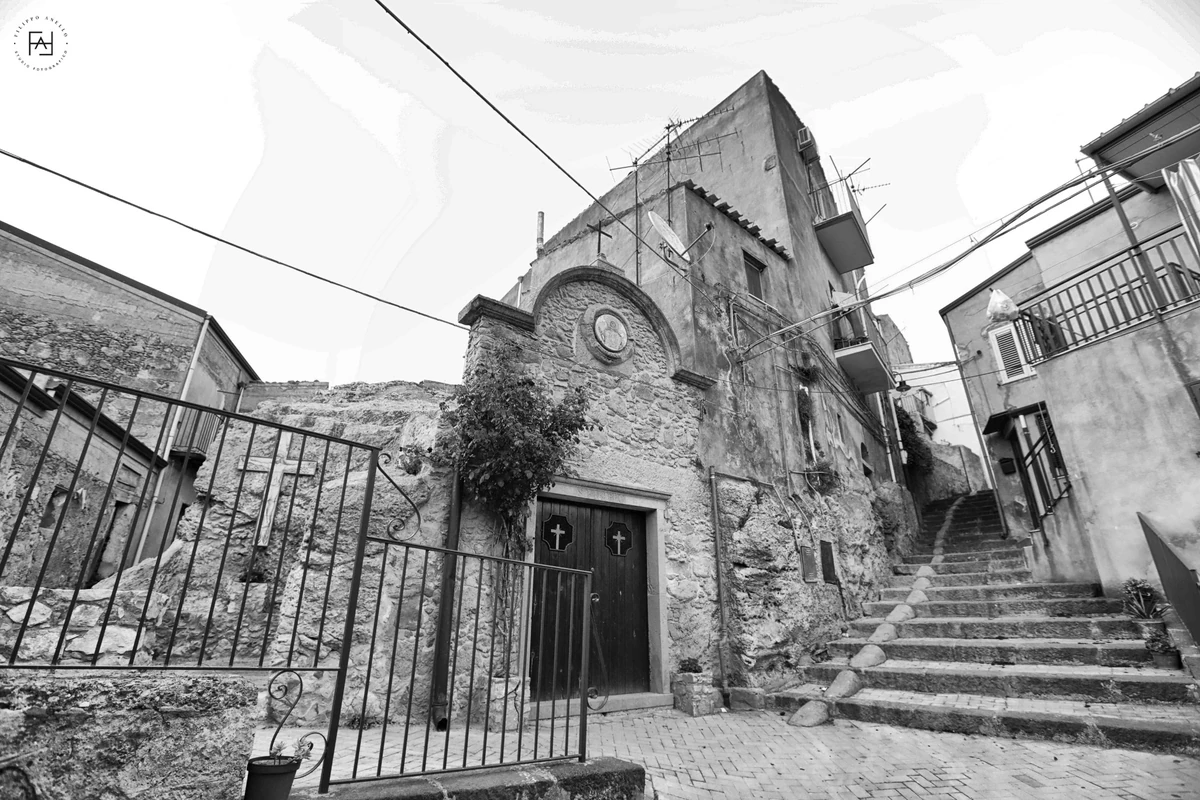
01 / THE PLACE
An ancient chamber carved into the rock, where the memory of the place meets stories and devotion to Agira’s patron saint.
HISTORY AND LANDSCAPE
An ancient place, before its worship.
Local tradition identifies the Cave of San Filippo as the saint’s first dwelling on arriving in Agira: a refuge for prayer and meditation, and the setting of struggles against the devil passed down in popular stories.
The archaeological interpretation suggests an earlier history. The chamber is understood as a late Roman underground burial place, which served different purposes over time and became a place of devotion.
The cave retains features associated with its funerary purpose, including arcosolia: arched recesses intended for burials.
Local historical accounts also describe a later use as a stable, when the ancient recesses are said to have served as feeding troughs.
These traces reveal the transformations of a space that has acquired different meanings and functions over the centuries.
Saint Philip’s dwelling in tradition.
According to tradition, Philip lived here, devoting himself to prayer and his religious mission. Local accounts also mention his companion Eusebius.
The side recesses, interpreted archaeologically as burial places, have been identified in popular devotion as the sleeping places of the two religious men.
These are distinct interpretations, both important to understanding the place: one concerns its ancient structure, the other how the community has remembered and experienced it.
Stories of struggles with the devil.
The cave is one of the settings of stories portraying Saint Philip as the conqueror of the forces of evil.
The struggles against the devil belong to popular religious tradition and help explain the deep bond between the people of Agira and their patron. In these accounts, the saint protects the community and confronts hostile presences through faith.
Marks on the walls have also become part of this memory: devotion has interpreted them as evidence of Philip’s presence and deeds.
The interior and the image on the wall.
Descriptions mention a narrow entrance flanked by burial recesses and a space that widens towards the back, where a painted wooden altar stands.
Traces of a wall painting, traditionally identified as Saint Philip, are recorded on the wall to the right of the altar. Local accounts report that some worshippers instead recognised an imprint left by the saint during a struggle with the devil.
The painting and its devotional interpretation are different aspects of the cave’s history. The date of the image remains uncertain.
A place of devotion in Agira.
Accounts of worship recall the observance in the cave of the seven Wednesdays dedicated to Saint Philip in preparation for the feast on 12 May.
This custom reveals an intimate aspect of devotion: prayer gatherings in a secluded space, alongside the public celebrations involving the town.
Continue discovering Saint Philip.
Combine a visit to the cave with San Filippo Abbey to explore the history of the saint’s worship and its role in Agira’s life.
The cave and the abbey crypt, known as the cateva, are distinct places: the former is remembered as the saint’s dwelling, while the latter is associated with his traditional burial place and the veneration of relics.
TAKE A CLOSER LOOK
Details make the place.
The arcosolia
The arched recesses reveal the chamber’s ancient funerary purpose.
The wall painting
Traces on the wall to the right of the altar and their devotional interpretation.
Memories of worship
Stories of the saint and the observance of the seven Wednesdays before 12 May.
THE PLACE, IN PICTURES
Change your perspective.
A closer look at the details and the surrounding landscape.
KEEP EXPLORING
One stop. Many directions.
Keep exploring Agira, with time for breaks.