Quiet, history and remembrance
Agira Canadian War Cemetery.
Agira Canadian War Cemetery · Agira, EN · Sicily
View photo01 / THE PLACE
Among the headstones and the landscape, a pause for remembrance. The Canadian cemetery preserves part of Agira’s history and invites you to approach it respectfully and without rushing.
LISTEN TO THIS PLACE
A place, many lives to remember.
Five chapters in English, from Operation Husky and the battle for Agira to the lives remembered among these headstones. Listen and read the transcripts at your own pace.
Audio in English · 5 chaptersA Place of Remembrance
- Listen 0:46
A Place of Remembrance
Read the transcript
Welcome to the Canadian War Cemetery of /A ˈdʒiːra/.
This hill preserves the memory of Canadian servicemen who died during the campaign in Sicily in the Second World War.
Before we begin, take a moment to look around. Notice the rows of headstones, the names carved into them, and the landscape beyond.
Nearly five hundred servicemen rest here. Their graves connect this place in the heart of Sicily with families and communities far away.
The cemetery’s history reaches beyond the battle fought for the town itself. Those buried here were brought together from different places across the island after the campaign.
To understand why they came to Sicily, and why this hill became their resting place, we must return to the summer of nineteen forty-three.
- Listen 1:01
Operation Husky
Read the transcript
The cemetery is directly connected with Operation Husky, the Allied invasion of Sicily.
Following the campaign in North Africa, the Allies chose Sicily as their next objective. They hoped to secure Mediterranean shipping routes, engage German forces, and push Italy towards leaving the war.
Airborne operations began on July the ninth, nineteen forty-three. The following day, Allied troops landed by sea.
The First Canadian Infantry Division came ashore near Pachino, at the southern end of the island. Together with the First Canadian Army Tank Brigade, it formed part of the British Eighth Army.
From the coast, the Canadians advanced into Sicily’s mountainous interior.
German forces defended hilltop towns and important roads to protect their route of withdrawal towards the Strait of Messina. The Canadian advance passed through places including Assoro and Leonforte before reaching the approaches to /A ˈdʒiːra/.
The campaign would continue until August the seventeenth. But here, one of its hardest Canadian battles unfolded in late July.
- Listen 1:00
The Battle for Agira
Read the transcript
The battle lasted from July the twenty-fourth to July the twenty-eighth, nineteen forty-three.
After taking Leonforte, the Canadians advanced east towards Nissoria and /A ˈdʒiːra/. German defenders held the surrounding heights, where they could resist troops moving along the road.
The first Canadian attacks met heavy fire and failed to break through.
The fighting then focused on three successive ridges between Nissoria and the town. Infantry units attacked with support from artillery and tanks, gradually overcoming the defensive positions.
On July the twenty-eighth, Canadian troops cleared the remaining ridge positions. Later that day, soldiers of the Princess Patricia’s Canadian Light Infantry entered and secured /A ˈdʒiːra/.
Veterans Affairs Canada describes these five days as the Canadians’ biggest battle of the Sicilian campaign.
Remember that much of this fighting took place on the approaches to the town. The name of the battle brings together a series of difficult engagements across the surrounding terrain.
- Listen 0:53
From the Battlefields to This Hill
Read the transcript
After the Sicilian campaign, the decision was made to bring together the graves of Canadians who had died in the fighting on the island.
In September nineteen forty-three, Canadian officers selected this hill in the territory of /A ˈdʒiːra/.
The cemetery therefore commemorates more than the battle for this town. Its graves belong to servicemen who died in different parts of the Sicilian campaign.
The Canadian account records both army personnel and members of the Royal Canadian Air Force among those buried here. Some could not be identified by name.
Others who died during the campaign have no known grave. These include Canadians lost at sea when their convoys were attacked on the journey to Sicily. Their names are commemorated at the Cassino Memorial on the Italian mainland.
This cemetery is one part of that wider remembrance: a place where individual graves preserve the human cost of the campaign.
- Listen 1:02
Behind Every Name
Read the transcript
One of the men buried here is Private William Rodgers Allison of the Royal Canadian Regiment.
He came from London, Ontario, and was twenty-three years old when he died on July the twenty-fifth, nineteen forty-three.
The Canadian Virtual War Memorial records that he was the son of David and Jane Allison, and the husband of Rosemary.
His grave is in plot B, row D, number one hundred and eighty-seven.
These few details remind us that a military record is also a record of a person’s life. A name on a headstone belonged to someone with a home and a family.
As you walk, take time to read the inscriptions. You do not need to know every detail of the campaign to recognise the loss represented here.
The connection between Canada and this place continues. In two thousand and thirteen, a ceremony marking the seventieth anniversary of Operation Husky brought together visiting Canadians, local people, and Canadian military personnel.
Remembrance is carried forward through such gatherings, and through quieter visits like this one.
HISTORY AND LANDSCAPE
Agira, July 1943.
Canadian troops landed in Sicily on 10 July 1943 alongside the Allies. During the advance through the island’s interior, Agira saw fierce fighting: the town was captured on 28 July, after five days of battle.
A place to remember.
After the Sicily campaign, the decision was made to gather the graves of Canadians who had died in the island fighting into a single cemetery. In September 1943, Canadian officers selected this site on a small hill in the municipality of Agira.
Look, read, pause.
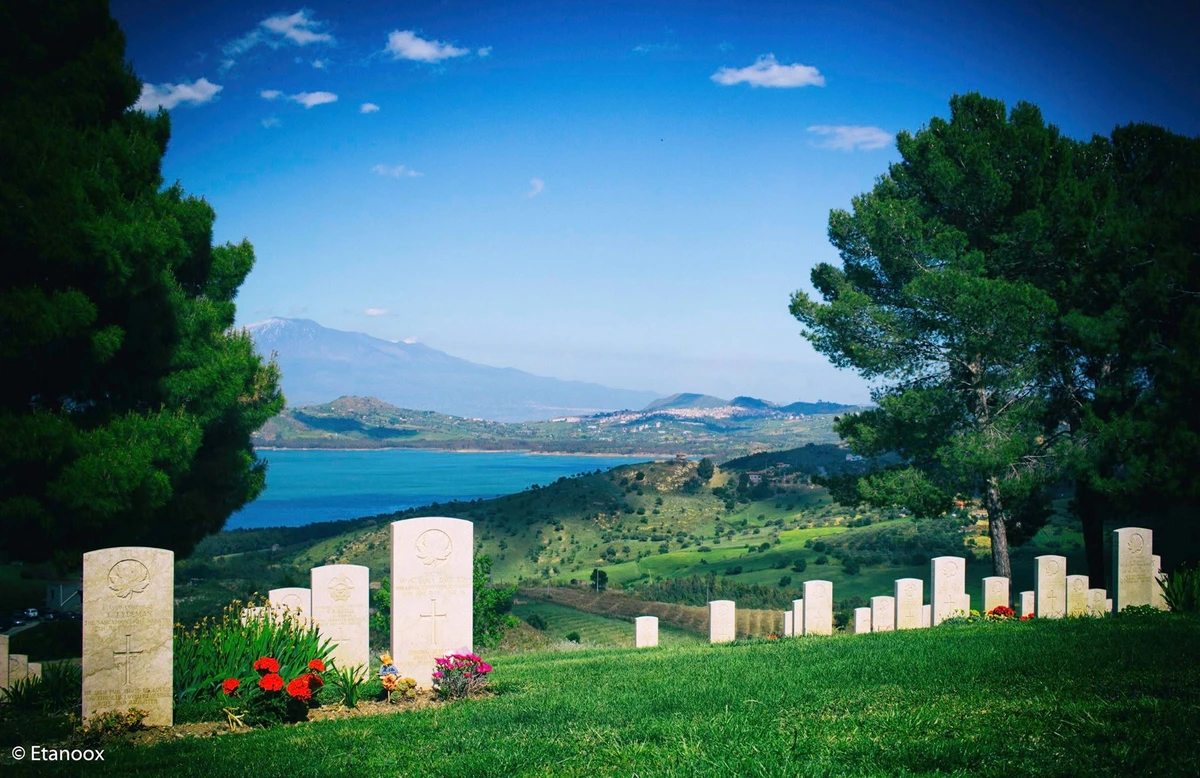
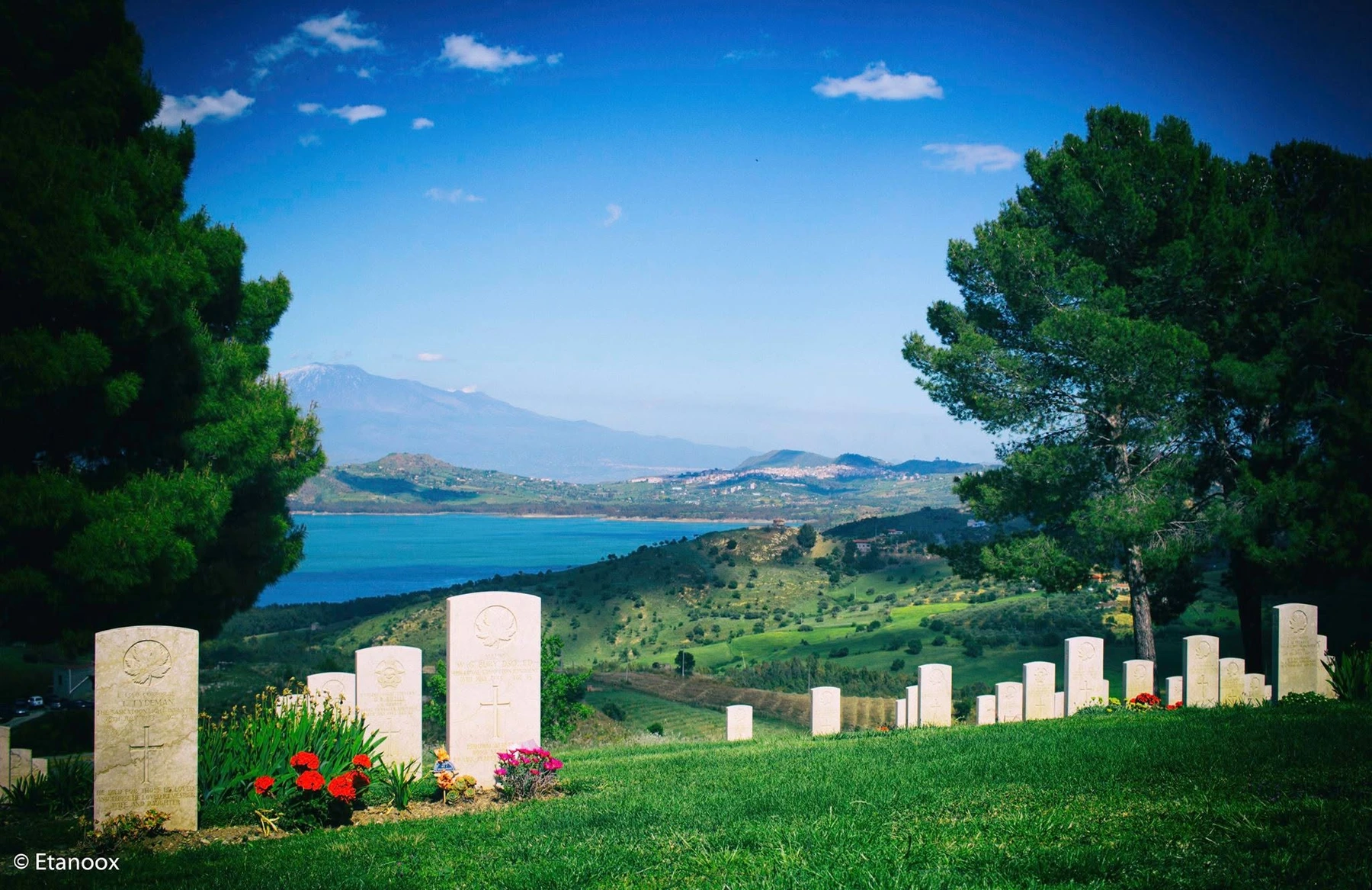
The photograph shows headstones on the lawn among trees, with Lake Pozzillo and Mount Etna in the background. During your visit, take time to read the inscriptions: behind every name is a life. The landscape accompanies remembrance rather than replacing it.
TAKE A CLOSER LOOK
Details make the place.
The headstones
Take time to read names and inscriptions, respecting the graves and other visitors.
The landscape
From here, you can see Lake Pozzillo and, in the distance, admire the majestic Mount Etna.
Sign the Guestbook
Before you leave, sign the guestbook and leave a few words. You will find it inside the niche on the left, just before the exit.
THE PLACE, IN PICTURES
Change your perspective.
A closer look at the details and the surrounding landscape.
Sources for further reading
KEEP EXPLORING
One stop. Many directions.
Keep exploring Agira, with time for breaks.